Networks grow in predictable ways.
Left to themselves, they expand through similarity. We meet people through people who resemble us — in background, profession, worldview, or ambition. Sociologists have long observed this principle of homophily: networks naturally become more homogeneous over time.
And yet, if we are serious about systemic change, we cannot rely on natural expansion alone.
Systemchange requires relational stretch.
Recently, I reconnected with a former classmate from secondary school. A simple conversation unfolded into something unexpectedly rich: we reflected on the sports we practiced as children and how those early environments shaped our professional identities today. Discipline. Competition. Collaboration. Endurance. Leadership. The architectures we trained in then still echo now.
What struck me most was not nostalgia. It was the reminder that our trajectories are shaped by systems long before we are conscious of them. And that reconnecting acrosstime — and difference — expands our social capital in ways that algorithmic networking never will.
This is one of the quiet invitations behind The Shift.
The book builds on the thinking of Donella Meadows, who taught that systems change when we intervene at leverage points: incentives, flows, rules, mindsets, and paradigms.
As the introduction frames it, real change does not begin with noise, but with “the quiet architecture underneath. Systems.”
Each contributor was invited to map a microshift — a small, intentional intervention— and identify the leverage point where they operate. The premise is both simple and radical: you don’t need to disrupt everything. You need to understand where to apply pressure so that reinforcing loops begin to work in your favour.
In the lead-up to unDavos, we were asked to write a chapter reflecting on this. That exercise alone was transformative. To pause and ask:
These are not branding questions. They are responsibility questions.
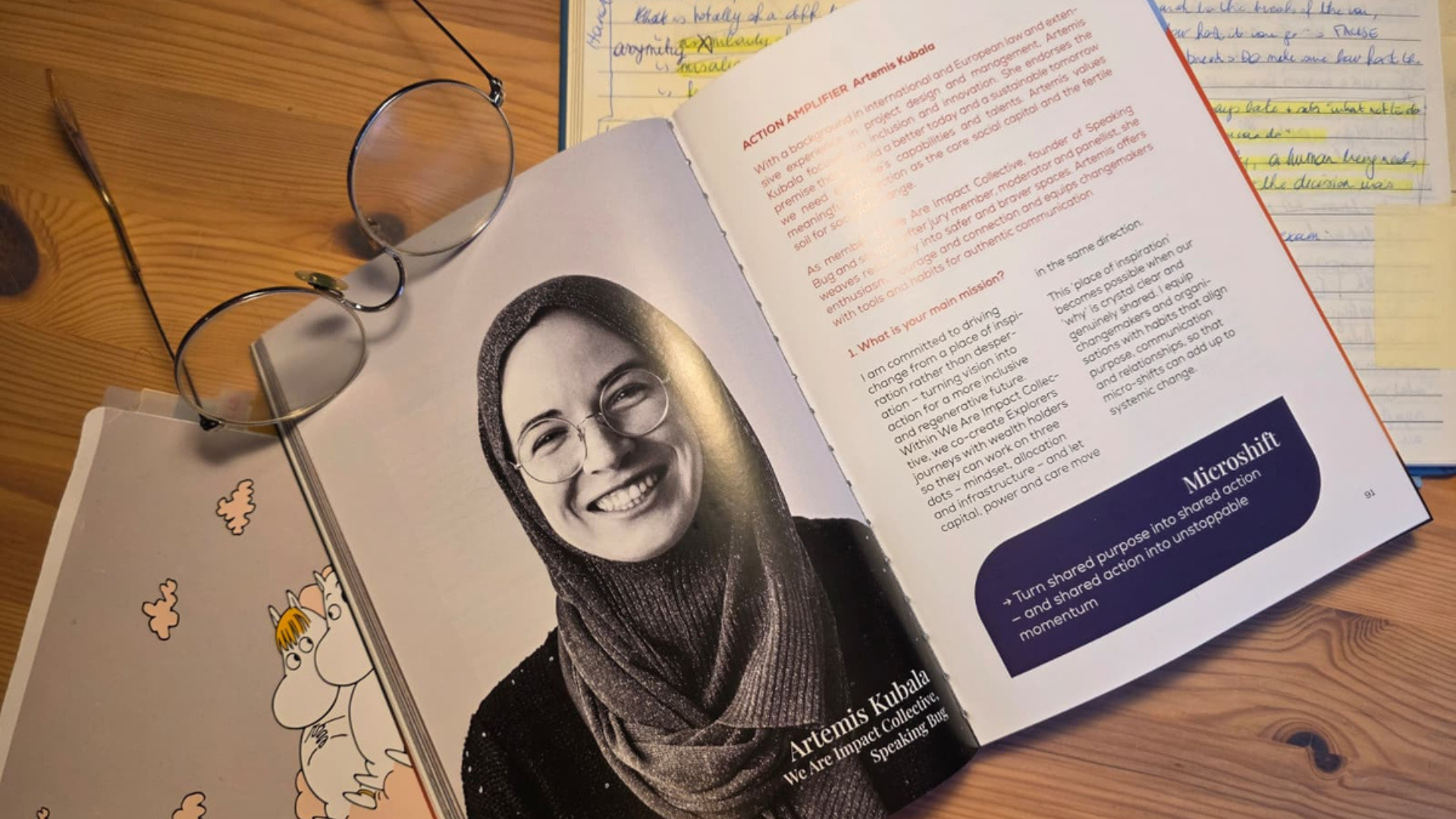
In the framework of The Shift, I was positioned within the archetype of the Action Amplifier.
An Action Amplifier strengthens reinforcing loops that accelerate positive change and weaken harmful spirals
The essence is momentum. Not heroism, but multiplication.
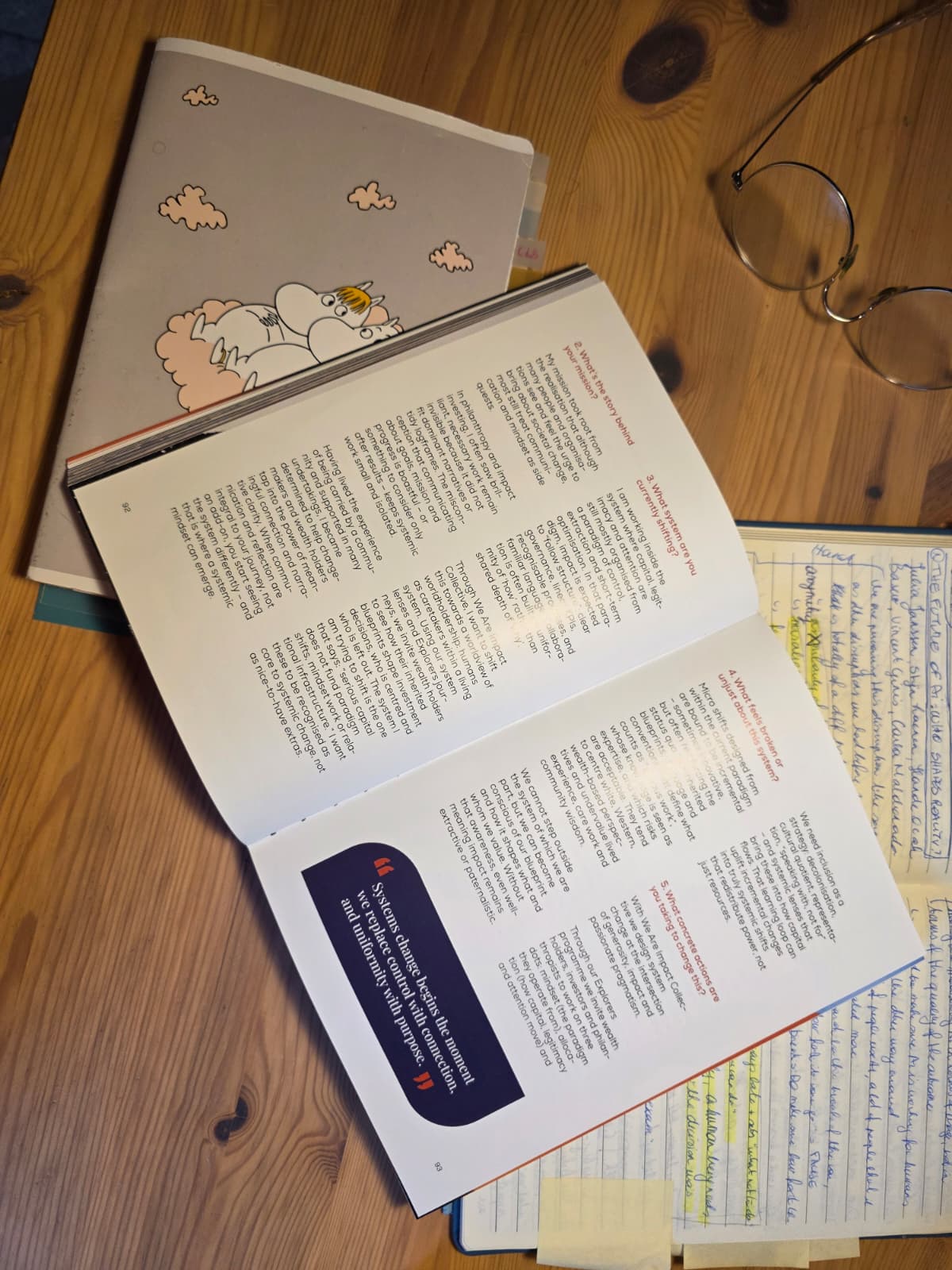
In my own chapter (p. 92), the leverage point is clear:
Position inclusion, communication and mindset as core infrastructure for systemic change — not add-ons.
The microshift I commit to is equally simple:
Turn shared purpose into shared action — and shared action into unstoppable momentum.
This conviction emerged from years of watching meaningful work remain invisible because communication was treated as secondary. From seeing capital organised around control, extraction and short-term optimisation
From noticing how collaboration is often built on uniformity of “how” rather than shared depth of “why.”
An Action Amplifier works precisely there — at the intersection of narrative, connection, and collective reinforcement.
Because momentum is rarely an accident. It is designed.
On pages 10 and 11, the book presents the twelve archetypes alongside well-known examples
Each archetype is illustrated through recognisable figures.
During our preparation, this sparked a lively debate.
Does including an example implicitly label someone as a “good example”? Does it import moral approval? And what about destructive amplifiers — individuals or movements that also understand reinforcing loops, but accelerate harm instead of healing?
Systems thinking forces this discomfort. Influence itself is neutral. Reinforcing loops do not carry moral intent. They simply compound.
The question is not whether amplification happens. It always does.
The question is: what are we amplifying?
And are we aware of the loops we are strengthening?
If systems shift when people shift, then who we surround ourselves with matters.
Natural networks tend toward sameness. Shared profession. Shared culture. Shared worldview. This is efficient, but it limits systemic imagination.
Enriching social capital means intentionally expanding beyond those natural extensions. It means reconnecting across time. Reaching across sectors. Inviting unlikely allies. Letting conversations challenge inherited blueprints about what counts as “serious work,” whose knowledge is recognised as expertise, and whose voices are centred
This is not diversity as optics. It is inclusion as infrastructure.
In my LinkedIn reflection What would you decide if you weren’t afraid?, I wrote about how fear quietly governs many of our choices — fear of being too visible, too different, too ambitious, too slow, too reflective. Systemic inertia is often maintained not by bad intent, but by unexamined caution.
System change asks a different posture.
Not reckless disruption, but conscious participation.
Not louder voices, but better loops.
One of the core invitations of The Shift is practical: define a microshift, identify your leverage point, gather eleven allies across the other leverage points, and share your story
The ambition is collective acceleration. Not individual heroics.
As the book states, “Action Amplifiers make change spread faster than resistance can slow it.”
The question for each of us becomes:
Because if momentum is designed intentionally, then shared purpose does not remain an inspiring sentence. It becomes shared action.
And shared action, when reinforced, becomes system shift.
If you are working at the intersection of impact, capital, communication, governance or innovation, I invite you to read The Shift in full.
Not as amanifesto.
Not as a collection of role models.
But as a systems lens.
Inside, you will find the twelve archetypes, the leverage points, and concrete microshifts that reveal how change compounds — and where it stalls.
You can download the digital version of The Shift here.
And perhaps, after reading, you will map your own microshift.
Because systems rarely transform through grand gestures.
They shift when enough of us strengthen the right loops — together.
If reflections on systems, leverage points and social capital resonate with you, you might want to subscribe to The Conversation Layer: my monthly newsletter through which I ocasionally share insights and field notes
It would be lovely to welcome you there.