
“If diversity is the air that surrounds us, inclusion is our breathing.”
Diversity is a given. It exists whether organisations acknowledge it or not. Inclusion, by contrast, is a practice. A choice. A daily action.
Yet in many organisations, I still see the same reflex: we measure diversity by counting identity markers. Gender. Age. Background. Nationality. Sometimes religion or disability.
It seems logical. What you measure, you can improve.
But if we take inclusion seriously, we need to ask a different question:
Not who is sitting at the table?
But: how was this table built?
Intersectionality helps us understand why this shift matters.
The concept was developed by Kimberlé Crenshaw, who showed how different forms of inequality intersect and reinforce one another. Racism and sexism do not operate separately. Class, migration status, health, skin colour, sexual orientation, age, religion — they interact and shape lived experience together.
In Europe, scholars such as Helma Lutz further developed this thinking. And long before the term existed, Sojourner Truth pointed to this complexity in her famous 1851 speech, “Ain’t I a Woman?” — highlighting how gender cannot be separated from so called race and social position.
Intersectionality teaches us one fundamental lesson:
People never exist along a single axis.
When organisations reduce employees to categories, they overlook this complexity. Worse still, they place the responsibility for inclusion on individuals’ identities instead of on the design of their systems.
Many organisations treat diversity as an end goal: a percentage that needs to be achieved.
But diversity is not a KPI.
It is an outcome of how you organise your work.
When recruitment and selection processes are fair, when onboarding is inclusive, when feedback can be given safely, when reward systems are transparent, when internal mobility is truly accessible — diversity follows.
Inclusion does not live in a policy document. It lives in hundreds of everyday practices: from employer branding to exit interviews, from psychological safety to data-informed decision-making.
And here lies a crucial distinction.
Organisations that focus on numbers tend to work on visible results.
Organisations that focus on practices work on the carrier.
When you make your practices inclusive, you build a foundation that can evolve. Not a policy tied to today’s definition of diversity, but a learning process that remains relevant tomorrow.
Our language evolves. Our insights deepen. What we see clearly today was invisible ten years ago. What we still overlook today will become clearer in the future.
An organisation that understands its own processes, questions them, and adjusts them when needed becomes agile. It does not need to start from scratch every time perspectives shift. It knows how to adapt.
That is sustainable inclusion.
This is why I prefer to speak of diversity competence.
Diversity competence is the ability to live, work and create in dynamic environments where diverse perspectives, worldviews, lifestyles and lived experiences come together and interact — an idea developed by Mounir Samuel in his reflections on (public) discourse and inclusion.
It is not a moral stance.
It is a capability.
And like any capability, it can be developed.
It requires practice in listening. In language. In recognising power dynamics. In tolerating friction. In adjusting processes when they systematically disadvantage certain groups.
For leaders, this means looking beyond metrics and shaping culture.
For HR, it means examining not only entry but progression and exit.
For teams, it means learning to engage difference without smoothing it away.
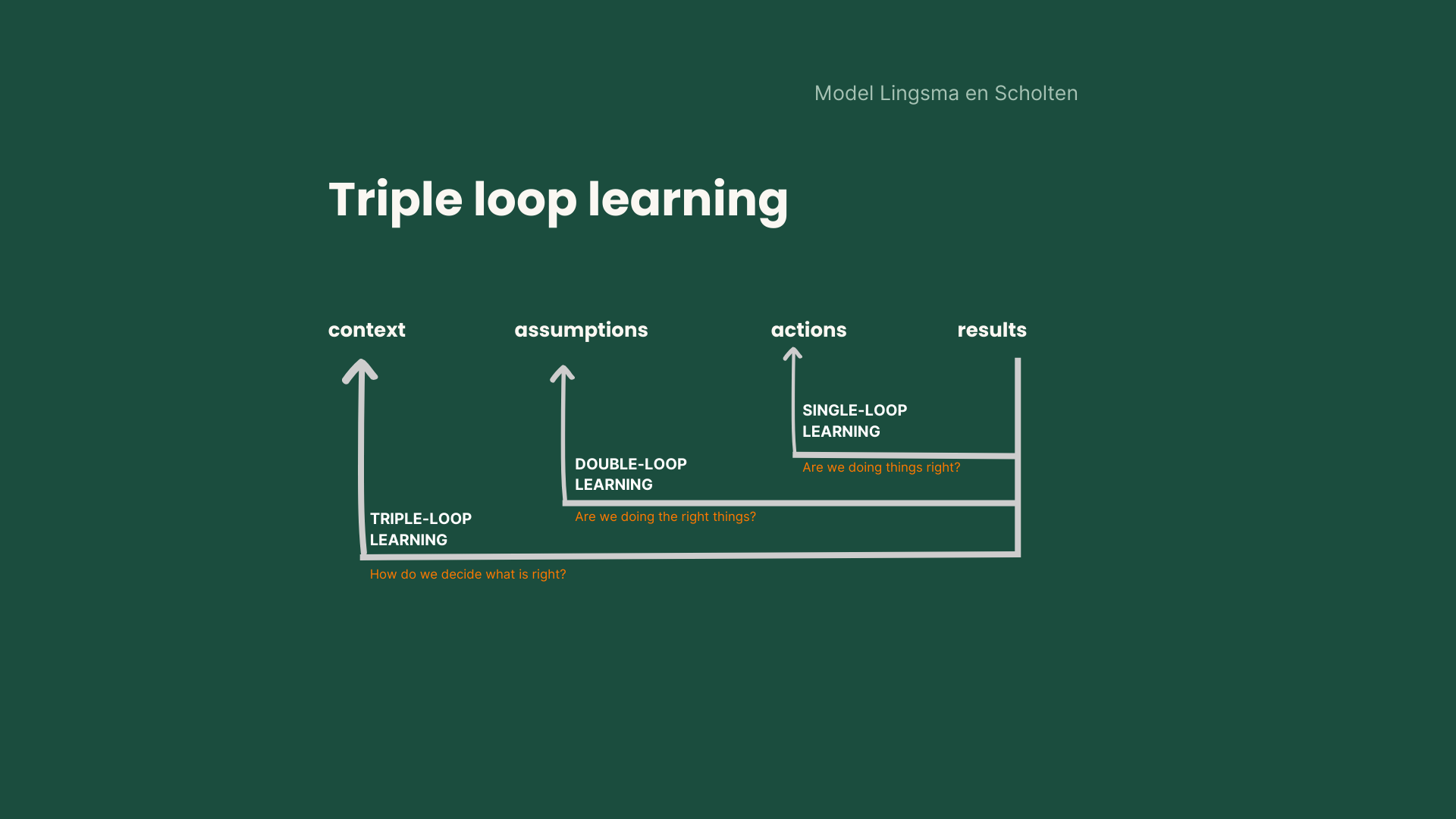
The model of triple loop learning helps anchor this work strategically.
• Single-loop learning: Are we doing things right?
• Double-loop learning: Are we doing the right things?
• Triple-loop learning: How do we decide what is right?
Many inclusion initiatives remain in the first loop. We improve procedures. We rewrite job descriptions. We organise training sessions.
This matters.
But meaningful inclusion requires that we also question our underlying assumptions.
How do we define “talent”?
What do we consider “professional behaviour”?
Which career paths are treated as standard?
Which life realities do we implicitly assume?
Triple loop learning builds resilience. It ensures that inclusion is not a trend, but a way of thinking and deciding.
If we take intersectionality seriously, develop diversity competence, and commit to learning across multiple loops, we arrive at a different conclusion:
Scan organisational practices for inclusiveness, rather than scanning employees for identity markers.
This means shifting our attention from individuals to patterns. From characteristics to context.
For example, ask:
• In which meetings do we genuinely integrate diverse perspectives into decision-making?
• When is participation in team activities high — and what does that tell us about accessibility and belonging?
• Which teams absorb unexpected absence smoothly, and how have they organised themselves to do so?
• How do we communicate effectively when language, reference frames or communication styles are not shared?
• Where has friction strengthened collaboration instead of undermining it?
• In which settings do feedback conversations flow well — and why?
• When do people feel free to articulate views that differ from the dominant narrative?
These questions make inclusion visible as a quality of interaction and organisational design.
They invite learning rather than labelling.
They help identify and strengthen effective practices.
They free inclusion from temporary definitions or passing trends.
Organisations that learn to look this way do not build snapshots. They build capacity.
And capacity is more sustainable than correction.
Are you working on culture, leadership or organisational development?
Join The Conversation Layer, through which I share new articles, practice scans and concrete tools on inclusion as strategy.