A book that didn't begin as a book
An didn't initially intend to write a book. She began writing about her own story at a particularly vulnerable stage of her life, when she wasn't doing well — a time of huge upheaval and emotional shreddedness. Writing was a way to bring her stories back to herself and to rediscover their emotional layers; she wrote, by her own account, about three times the volume of the eventual book. Only when she shared parts with friends, who told her there was something more in it than just her own life, did she begin to realise there was a book in it.
The limits of academic language
Early in her life, An chose to express herself in academic language, because she saw legitimacy in it. But over time she came to see its limitations: how much cannot be told in scientific language, how it puts distance between writer and subject, and how English — and to a lesser extent French and Spanish — silences voices not expressed in those dominant languages. Her book felt like a kind of "vengeance" of her own way of writing, long locked up in academic form. The form is also a metaphor: as an academic you tend to tuck away the fact that you're also human, a whole person. In her discipline — she was trained in quantitative business economics — she learned that her own story, her emotions, her human side were not legitimate, and that giving space to them was even a scientific mistake.
The risk of vulnerability
A narrative style and emotionality as a subject: An felt the risk. One colleague even advised her not to publish — "that's something you should do when you're sixty, because it's very risky to show yourself as a vulnerable human being; at your age you don't have that luxury." Yet she chose to dare to speak, inspired by her research participants, who shared their stories at far higher risk than she ever took with this book. Looking back, the writing was both liberating and exposing: liberating because she claimed the space for her story, particularly within herself; exposing because the stories are now out there, to be related to, but also to be abused.
No happy ending, but room for doubt
An deliberately wove her doubts and worries into the tissue of the book. At one point she thought she wasn't entitled to publish until she had figured it all out — until she realised that figuring it out is an illusion. Better to give space to the doubt itself. There's no happy ending, no culmination, no aha moment of acquired wisdom. Life is simply navigating through, and that's exactly what makes it beautiful — including the doubt, including the uncertainty.
Vulnerability as luxury — and as privilege
Vulnerability shouldn't be a luxury, and yet it still is, An acknowledges sharply. She could write this book because she has stable employment, because she could take the time to reflect. That luxury is tied to job security, nationality, but also to class and skin colour — to the way a white European woman is granted a stage and a space that wouldn't have been so obvious for a Black African woman. She felt she had to do her part, otherwise her message — more space for stories — wouldn't be coherent.
From option to duty
Whoever has an option is in a position of privilege. For An, that option became a duty at certain moments, particularly when she began to speak about her post-traumatic stress. At first she thought she was alone, until she realised how many people in her field carry an emotional weight in their backpack. So grew the conviction: we need to know more about this, the academic world needs to recognise the toll research can take — the need for care, for time to reflect, for professional health care. It became partly a mission, sometimes even an obsession — for instance around how little space there is in academia to talk about harassment during research. She had to find her own pace in carrying that larger story, without standing on every barricade at once.
The forest as a mirror
Throughout the conversation — and the book — An keeps returning to nature as a force that regulates and restores balance. Trees and forests are, for her, a metaphor: you see the trees above the ground, but you know they're connected underground in an ecosystem that collaborates, sometimes competes, but exists together. Trees outlive humans — a lesson in modesty that puts things in perspective. And even when a tree falls, it never entirely disappears: what falls onto the soil remains part of the ecosystem. That metaphor she carries, particularly in relation to two people she calls Amy and Davina in the book - who both, sadly, passed away, and whose heritage she carries with her. Mourning, she says, is a phase in which you make space for the heaviness, but also for the joy and light you shared.
The responsibility of listening
What responsibility comes with listening to stories? For An, the first is to really listen. A researcher doesn't simply come to talk, but to collect data — which is precisely why, with people enduring trauma, conflict or poverty, you must give space to all aspects of their story, not only to what you need, and respect their silences too. A researcher isn't entitled to everything in the name of science. Silences carry meaning — a language of their own. As researchers we're often obsessed with the exact citation, while people share so much between the lines. She tells of a village head in Rwanda who, as they walked, kept singing the praises of maize (an obligatory crop), while the crop was clearly failing and forbidden sweet potatoes stood nearby. To her remark — "interesting maize you have here" — he replied: "yes, this is the best maize we've ever had." Researchers should be interested in what people hide between the lines: silences, little laughters, double meanings — and even a refusal to talk is part of the research, with a reason of its own.
Protecting yourself — and caring for yourself
Holding on to a research target is sometimes also a form of protection, because as a listening researcher you can quickly become emotionally overwhelmed. Sometimes you end up in deep emotional layers without realising how you got there. That's why An stresses that research on emotionally charged topics requires not only good preparation and methodology, but also self-care: enough breaks, space in your own life to process the emotional charge, and the courage to step away when you're overwhelmed. Researchers have long been both underestimated and under-equipped in this: there are beautiful courses on theory, method and research ethics, but rarely on the emotionality of research. For five years now, An has organised a residential winter course on this very theme — not without resistance from colleagues who didn't see its use.
Ethical dilemmas, and the illusion of competition
Research ethics isn't a checklist, An stresses: in complex research fields you inevitably end up in ethical dilemmas, however well prepared you are. Those dilemmas have no easy, black-or-white solution — it's about learning to navigate, and above all about not staying alone. Crucial is being surrounded by a group that won't judge you, because whoever feels judged becomes defensive and reaches for simplistic answers. She calls for structures built into the academic world, for professional health care like that which exists for doctors, firefighters or the army — and not only for "exceptional" cases, because in the age of fake and post-truth, many researchers face intimidation and pressure. She doesn't believe the best science is created through competition; the best science grows from collegiality and people working together.
Positionality and learning to see privilege
An describes herself as a white, European, academically privileged researcher working in regions marked by colonial histories and global inequalities. She thought she was very aware of this in the beginning, but really she wasn't — because the thing about privilege is that you often don't realise what it means to not be privileged. Everyone has fields of vulnerability, but it's important not to equate your own with what others go through: being a white Belgian woman in academia isn't the same as facing racism or class discrimination. Through years of working with African colleagues — the large majority of her team — she only saw, after many incidents, the systematic racism she could easily have taken for exceptions as a non-Black person. It's important that those who aren't the target of discrimination speak out, so the burden doesn't rest solely on the shoulders of those experiencing it.
Giving a stage that doesn't become violence
During a diversity week at her university, An saw how painful it was for Black colleagues to have to speak on stage about their humiliations — almost like asking someone to undress. When that moment isn't followed by concrete measures, it becomes a form of violence in itself. Privileged people often don't realise how harmful and traumatising it can be to publicly express vulnerability, and think that by giving an underrepresented voice a stage they're doing something great. An had the time to reflect on which story to tell and which not; underrepresented voices often don't get that time — they're thrown on stage to represent "the Black voice" or "the Muslim voice." For her, decolonising means, first and foremost, being aware of your own privilege and power, and daring to touch your own fields of discomfort.
A bridge, or falling between worlds?
An moves constantly between worlds: Europe and Africa, academia and communities, data and human stories. A Congolese artist once suggested drawing her with one leg in each world. Sometimes those worlds are close and it's easy; sometimes they lie far apart and the stretching hurts. Whether she's a bridge, she isn't sure — but she does stand on the bridge, neither fully here nor there, always a bit shredded, but also beautifully connected to different worlds. She wouldn't want to be anywhere else.
Secondary trauma, and the Lara Croft myth
One of the most striking parts of the book: how hearing so many stories of conflict and suffering eventually led to her own post-traumatic stress — something researchers rarely speak about openly. For a long time An didn't realise it, partly because she took so few moments to rest or step back. She saw herself as a kind of "Lara Croft": the tough woman who runs through an imploding world and comes out alive and still cracking a joke — an image that also fits the macho culture of academia. She didn't even know secondary trauma existed. Only when she was deep in cycles of panic attacks, and her psychologist told her "I think you're traumatised," did it begin to dawn — though she laughed at first, because in her eyes trauma was reserved for those who had survived a genocide. She wrestled long with the "legitimacy" of her trauma, until her body provided physical proof.
The body knows
The body knows how to regulate — but many scientists have learned not to listen to their bodies. An recognised that: she long saw her body as an engine carrying her from A to B, performing what her head decided. She thought overcoming physical discomfort was a strength; now she knows it was a flaw. The conversation touches a shared experience — Artemis recounts a day of crying on a rooftop during research in Palestine — and arrives at the importance of a decompression mechanism that works: crying, or something else, but not a destructive relationship with your body.
Art as a language of its own
The book is accompanied by illustrations by Odile Uwera. For An, art isn't decoration that comes after the science: art has its own language and often expresses what science cannot. In collaborations between art and science, we shouldn't always put science first. She tells of a recent workshop in Northern Congo where deaf participants performed sketches in sign language that no one literally understood — and precisely thereby brought something to life that hearing attendees could never have captured in that way. Where you can see shortcomings in people, you can also see possibilities.
What the writing changed
The writing was a turning point. An found more peace of mind, became softer — toward herself and toward her surroundings — and more attuned to who she is. She now sees, more than ever, the beauty of encounter, and deliberately makes room and time for it instead of squeezing it in between "the actual job." Her advice to young researchers stepping into complex social realities: dare to lose time. In our rat-race society we're so preoccupied with to-do lists; dare to make time for a coffee with someone you don't immediately see as "useful," because true inspiration often lies in the unexpected encounter. And what she hopes readers carry with them: the legitimacy of their own story — the uniqueness of every story and its worth to be told, to be shared, to be given space.
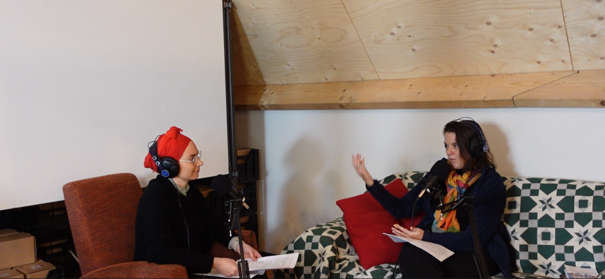
Space for Stories by An Ansoms was the starting point for this conversation. Don't want to miss an episode? Subscribe to Kom Maar Dichter on your favourite podcast platform, and join The Conversation Layer — and each conversation, transcript and extra reflection will land straight in your inbox.