
A book that had been quietly waiting for years
Deniza had long known she would write one day — she just hadn't expected it to be now. For years she felt she didn't yet have enough "material," enough experience; that she was still too young. Until a journalist, after a long phone conversation about identity, discrimination and diversity, asked her almost in passing: have you ever thought about writing a book? That single question rekindled a fire that had been burning since her childhood library years. Within a year — a deadline she set herself, and cursed herself for more than once along the way — Tussenin was written.
"It's our story" — a voice for a generation
Tussenin begins with Kosovar identity in the diaspora: the first generation to grow up outside Kosovo, who developed a story of their own while caught between the often contradictory expectations of two cultures. Deniza missed this book in her own bookshelf — it simply didn't exist yet. The longing for home, the romanticising of a country that at the same time no longer quite exists, the tension between where you come from and where you ended up: these are experiences she shares with Kosovars in Germany, Switzerland, France, America — and that resonate with anyone carrying a migration background.
Patriotism versus nationalism
One of the finest distinctions in the book: the careful line Deniza draws between patriotism and nationalism. For her, patriotism is about love for a country — about preserving language, music and culture — not about feeling superior to anyone else. Nationalism, the closed form that excludes, she deliberately avoided. It's characteristic of how the whole book works: balanced, careful, attentive to the weight of every word.
Writing in places that matter
Deniza isn't a writer with a strict rhythm — she writes in the early morning and at night, when it's quiet and the world around her sleeps. She began with a brain dump and a paper mind map, worked chapter by chapter in separate Word documents, and only later pasted them together into something that began to resemble a book. The most important lesson she took from YouTube writing tips: write first, edit later. Reaching for the perfect sentence from the start only blocks your own creative process. The chapter about returning to Kosovo she wrote deliberately on location, in her grandfather's house — because certain feelings simply can't be summoned in Belgium. "It's as if a Deniza wakes up in me there who isn't awake here."
Conversations as a sounding board — and as documentation
The book grew out of spontaneous conversations with Kosovar friends, which naturally turned to home, relationships, expectations. But the most precious were the conversations with her mother, about the details of their flight and the war. For the first time, Deniza asked not only what happened, but on which date, and how it felt. In doing so she captured stories that might otherwise have been lost — including those of her grandmother, a tough, quintessentially Kosovar woman who rarely shows vulnerability.
Translating the book into Albanian: giving back a piece of dignity
Tussenin was written in Dutch, but Deniza translated it into Albanian — the language in which her mother made her feel at home. It's more than a translation. It's a way of giving something back: to her mother, who once, after her working hours, passed Albanian on to her children in an era when the language was banned in Kosovo; and to a whole generation of parents and grandparents who would otherwise never be able to read what their children wrote. Where many diaspora authors choose English to reach a wider audience, Deniza deliberately chooses the mother tongue — so the story lands with those it concerns most.
Socialmedia, stereotypes, and the pain of exclusion from within
Social media play a double role in the book: they connect the diaspora, but they also amplify caricatures. Deniza writes about how the diaspora is sometimes mocked — for their accent, their "too Western" ways, their nice clothes and cars. That it comes from within their own community hurts all the more. Her book is also an outstretched hand: an invitation to approach one another more gently, and to recognise how difficult things were here, too.
On racism — and the courage to name it
Deniza wrote the chapter on racism with great hesitation. For a long time she doubted whether she had "the right" to: was it racism, or exclusion, or being looked down upon? She grew up with the message to be grateful, not to complain, not to stand out — an internalised pattern that makes it hard to see yourself as someone wronged. Yet she chose to name it, also on behalf of her parents and family members with darker features. The conversation touches on a broader theme: that racism is more than skin colour, and that Eastern European migrants experience a form of exclusion that little has been written about.
Shame, assimilating in two worlds, and handing the discomfort back
As a child, Deniza wanted to be as Flemish as possible — she felt ashamed when her father spoke loudly on the phone in the supermarket, refused the beautiful clothes her mother bought in Kosovo, and painstakingly re-adjusted after every summer holiday. Looking back, she feels compassion for that girl who poured so much energy into "fitting in" rather than simply being herself. Today she practises something different: handing the discomfort back to those who cause it, rather than silently carrying it alone.
Guilt as an engine
"Guilt became my engine." As Deniza grows older, she understands more sharply what her parents' sacrifices truly meant — educated people who went to work in a factory so their children could have a chance. The talents and skills it takes to build something from nothing go unused and unseen. That sense of guilt partly explains the high pressure many children of migrants feel to give something back, so their parents might still share, even a little, in the recognition they never received themselves.
An ode to her father — and to more
The writing process was also a kind of therapy: learning to name things, to place them, to know herself better. And it culminates in an ode to her father, who died of cancer eight years ago. On one of his last evenings he passed on his Amanet — his final wish — in which the writing of the book had its place. He was the man who taught her, as a Kosovar girl, to stand tall; who never shied away from a single uncomfortable conversation; and who never received the recognition he himself had hoped for. The closing chapter makes clear that Tussenin is an ode to him — but also to her parents, to a refugee story, to a migrant story, and above all to the state of being in between itself.
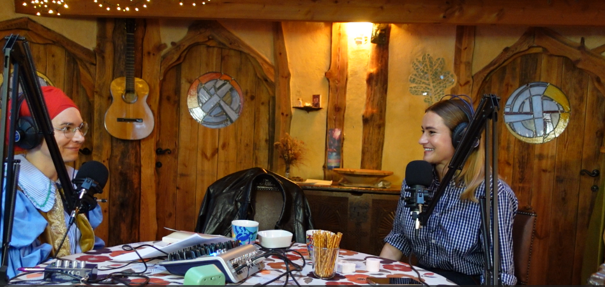
Tussenin by Deniza Miftari was the starting point for this conversation. Don't want to miss an episode? Subscribe to Kom Maar Dichter on your favourite podcast platform, and join The Conversation Layer — and each conversation, transcript and extra reflection will land straight in your inbox.
Come closer.