
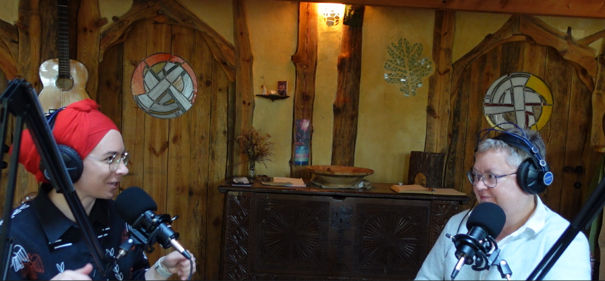
A running thread through a whole life
The book dates from 2013, but the theme won't let go of Ingrid — it is, she says, the running thread of her life. Her focus on mediation grew from personal experience: in a work context she saw how tensions and outright conflicts were swept under the rug, ignored, or how scapegoats were sought. People don't enter the conversation because it's uncomfortable — often with the argument "I don't want to hurt anyone". She wanted to become skilled in it, took the lead, had herself trained. She wrote the book together with her colleague Sandra Peeters: a form of synchronicity, born from the realisation that they had to put something on paper to inspire people to take it up themselves. Because, she says, the ideal is really that the mediator becomes superfluous.
Is the urgency greater today?
In general, Ingrid sees a positive evolution — just look at the growing range of courses in mediation and nonviolent communication. But it depends heavily on sector and organisation, and a worrying second trend is emerging: the fear of losing one's job makes people more cautious about speaking up. The more hierarchical a company, the more room for abuse of power, and the greater the danger that what's been learned no longer makes it into practice. There's a cultural layer too: the Flemish sit on the dividing line between Germanic and Latin cultures and lean more toward a "shame culture" — find it harder to admit mistakes — whereas Latin cultures often make more time for dialogue.
What is a conflict, exactly?
A disagreement or discomfort you can still talk through and resolve is just a tension — it doesn't linger. A conflict is what gets stuck: both parties dig into their positions, you don't reach a supported solution, and the situation starts to cause damage — human and professional. It stands in the way of the team's or the organisation's progress. And that's precisely when a third party often comes in.
The mediator: a role and a skill
A mediator takes no position and isn't a "judge", but listens to all parties, explores the system and the team dynamics, and facilitates the conversation with skills like active listening and giving people the floor. A fresh outside view, undimmed by the organisation's culture, has its advantages: an outsider sees and names things an insider doesn't dare to, or doesn't see. Importantly, Ingrid almost always conducts individual intake conversations first — not everyone around the table straight away, because that's uncomfortable and colours the stories. In full transparency: what someone shares only goes on the table if they want it to. She often draws a "conflict map" or "conflict tree" to grasp the underlying causes. But the role is also a skill you can apply without a formal mandate — and really, a mediator mainly trains those involved to be able to do it themselves in the end.
Meeting yourself in the work
Mediation confronts you with yourself. Ingrid speaks candidly about once landing in a work culture where mistakes were immediately punished — "attack is the best defence" — and how, as an outspoken twenty-something, she gave plenty of pushback but wasn't open to good feedback. In her early thirties she realised: this isn't who I want to be. She also came to know her own pitfall: rushing too quickly toward a solution because she wants it to be good for everyone — thereby sweeping things under the rug and not giving the process a chance. As a consultant she had to learn to set her solution-focus aside and deploy her facilitation skills instead: not filling in the answers, but asking questions and gently offering options.
Neutrality doesn't exist
"We can't take off our human coat." Neutrality doesn't exist — everyone has a position, their own intersection of identity characteristics, shaped by upbringing and life experience. A mediator has to stay constantly aware of this and keep checking in. Ingrid tells of a court-ordered mediation in which she sensed, as a woman, that a man wasn't comfortable with her mediating; she turned it into a co-mediation with a male colleague. Trust, she says, comes on foot and leaves on horseback: the moment a party perceives that you're taking sides, it's already forfeited.
When mediation isn't possible
Mediation stops where there's no willingness left at all — when people would rather go over the cliff together than give an inch. Ingrid experienced it with two company directors who refused to see that there was a higher interest than their own; the company went bankrupt, taking all its jobs with it. If one party genuinely won't compromise, or if a manifest imbalance is being exploited (think of children subtly being used in a divorce), a mediator has to pull the plug themselves. Then the legal route remains — but an imposed decision feels very different from a solution people carry themselves. With a judge there's always loss; with a supported solution there isn't.
Conflict competence as a management skill
The book makes a case for conflict competence as a core leadership skill. Why, Ingrid wonders, is compulsory training in financial literacy or reading a balance sheet so self-evident for new managers, while conflict competence isn't? A leader takes turns wearing the hat of mentor, coach, referee or facilitator. It's less about knowledge than about keeping the team dynamic healthy and keeping the focus on shared goals. She refers to the "energy" aspect from the Six Batteries of Change: you can hit your goals and still end up with a flat battery if it's always the same people pulling the cart — and that breeds tensions and conflicts over time.
From person to system: policy, not one hero
It mustn't depend on that one conflict-competent person, because if they leave, it's over. So it begins with policy — without policy, tools stay marginal. Management has to embed conflict competence in the strategic objectives, tied to concrete behavioural indicators, so that friction is tested against the policy and not against the personal interpretation between colleagues. Ingrid gives the example of the cultural transformation at Smart, with training in Authentic Relating, feedback and feed-forward, and intervision — a thoroughly process-based approach. Because conflicts are normal, sometimes even necessary: if everyone always nods yes, you stand still. Friction creates shine — provided you handle it well.
Open communication, empathy and the four levels of listening
A surprising nuance: for Ingrid, empathy does not mean stepping into someone else's shoes — since a life experience is, after all, impossible to truly replicate. Empathy is rather the willingness to lean back and listen sincerely. She draws on Theory U and distinguishes four levels of listening: confirming listening, listening to the facts (still for yourself), empathic listening (switching off your judgement, asking questions, truly hearing), and finally generative listening — where, out of the space you give one another, something new arises spontaneously, a shared wisdom. That demands a high quality of listening, rarely found at a business table full of figures.
Acknowledgement — from the interpersonal to the colonial past
An essential part of empathy is acknowledging that something matters to the other, even if it matters less to you. Fail to do that, and you fail to acknowledge an important part of who someone is — and then people close off, go "out of connection". Ingrid extends this to the broader societal debate on decolonisation: you can bear no guilt for the colonial past and still carry the responsibility to acknowledge something and move forward constructively. No guilt doesn't mean no responsibility. That acknowledgement creates space — and from that space you can look together, with new energy, at how to design things differently for the generations after us.
The last word — and what comes next
Ingrid's tip to the book's original readers: it's never too late to learn new skills, and never too late to acknowledge that you didn't handle something well in the past. She tells how she once reached out to a friend with whom things had gone wrong — they didn't become friends again, but it cleared the air and made negative energy disappear. Apologising sincerely is a skill we learn too little. At sixty, she also took up a long-cherished project: Mens in turbulente tijden ("Being Human in Turbulent Times"), a series of pieces (for now via LinkedIn) in which she holds conversations, writes poetry, and hopes something generative arises — a platform for people working toward a warmer, more sustainable, more regenerative society.
Conflictbemiddeling op het werk by Ingrid Larik was the starting point for this conversation. Don't want to miss an episode? Subscribe to Kom Maar Dichter on your favourite podcast platform, and join The Conversation Layer — and each conversation, transcript and extra reflection will land straight in your inbox.