
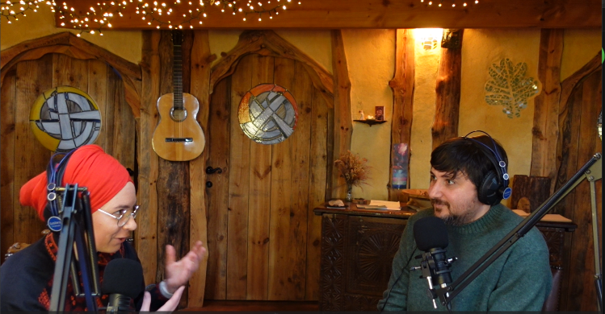
First, a human at the table
Majd would rather sit at the table first as a human than as an expert. His work is a stressful job, the news rarely positive, the world heavily burdened — and it helps him, wherever he ends up, to start from that human "baseline". Only afterwards do the journalism, the books and the Middle East come up of their own accord.
Nine years of silence — and why writing is such a heavy process
Nine years separate his previous book from this one. Not because he stood still, but because writing is, for him, a painful, all-consuming process: an enormous investment of time and emotion, in which you open heavy chapters you'd rather not handle so deeply. Het licht van de twijfel also emerged in a leaden period — a genocide in Gaza, months of harrowing images of dead children that he had to watch eight hours a day as a journalist. Majd, by his own account, isn't a hurried writer: he waits, takes his time, doesn't leap into every debate. Writing became a therapeutic process for him — and more than once he had to stop to wipe away a few tears in secret at a café.
Writing emotionally, seeing cinematically
Anyone who reads the book notices how emotionally charged the language sometimes is. That's no accident: it springs from Majd's Arab identity, where at school you learn to write emotionally, almost poetically, in a language extraordinarily rich in images and expressions. He deliberately did not want to write a journalistic book, but something honest. The text also reads cinematically — as a documentary maker he saw the passages as scenes — and that sometimes collides with the weight of the subject. How deeply do you describe the cemetery where your mother lies? Which stone, which branch, which colour do you still name? (And, he jokes, anyone who really wants to get rich had better write a cookbook than an emotional book.)
Fleeing in order to write
To be able to write, Majd had to escape each time — from reality, from his comfort zone, from his surroundings. Many parts he wrote abroad, in Cairo, or closer to home on a bench by the water in Grimbergen (until the laptop battery died and he discovered that portable chargers exist). The book opens confrontingly, at his mother's grave in Damascus — one of the places where he had to pause after only a few minutes.
Genocide, and protecting yourself
As a Middle East expert, Majd knew exactly what was happening, and yet: his generation doesn't know what a genocide is — you hear the word, but you don't know it from the inside. He describes how one shock followed another as international organisations sounded the alarm and politics looked away. To be able to keep doing the work, he sometimes had to protect himself: occasionally he asked to stop covering Gaza for a day, he turned to a therapist to ventilate, and he found release in humour and in football — a trip to Barcelona to see his stars, and straight back to Brussels afterwards.
Wanting to be timeless, personal and informative
The relief at finishing was mainly a production relief; with a subject like this, no real emotional relief exists. One thing did reassure him: that he had written every letter with enough awareness. Majd wanted a book that stays timeless — no small feat for a conflict that changes by the day — and one that doesn't only make you feel something, but also teaches you something. That's where his journalistic streak shows: making complex political matters accessible without simplifying them, and looking for where the gaps in information are (apartheid on the West Bank, the impact of Israeli laws on Palestinian citizens, the lack of freedom of movement for Palestinian refugees in the Arab world).
Constructive versus destructive doubt
The beating heart of the book: the distinction between constructive and destructive doubt. A simple test, Majd says — if doubt leads to connection and less conflict, it's constructive; if it sows division (divide and rule, disinformation, political extremism), it's destructive. Constructive doubt holds a great deal of empathy within it: you prod at fixed convictions, not to prove someone right or wrong, but to ask whether we might look at a situation differently. You have to be able to step into the other's shoes and acknowledge their trauma — even on "the other side" of a conflict. In a time when extremist voices are growing louder everywhere, that constructive doubt feels, to Majd, more urgent than ever.
The press, power, and a world you wouldn't believe
Majd also calls politics to account — not only for what it says, but for what it leaves unsaid. He misses the journalist who dares to put a foot in the door, in an era when politicians need the press less and less and turn straight to social media and AI. Current geopolitics, he says, is so absurd that ten years ago you wouldn't have believed it in any Netflix series. Precisely for that reason he wants to keep shocking, keep shaking people awake, and keep questioning power for as long as he can.
How to practise constructive doubt
Constructive doubt isn't a disposition but a skill, and one you can practise — even if you're not a journalist. Majd's three keywords for journalists: data, testimonies and insights. For everyone else: read, or otherwise listen. Seek connection with your fellow human — not by handing out blankets, but by truly listening. People who have just arrived often need a conversation most of all. Just say hello on the street. Look past the cliché story to the person behind it: how was school, who were your best friends, do you know Damascus? And, if you can, travel — dive into the other's version and trauma, not necessarily to change your opinion, but to acknowledge.
Being a migrant is a full-time job
In this book, Majd isn't concerned with integration or civic onboarding — learning the language, finding work, making friends — but with the emotional and social costs of migration. As the only "foreigner" on the foreign desk, he permanently feels like that migrant too; during crises like the attacks in Brussels and Zaventem, he reflected sharply on how terror knows no colour or language (many perpetrators were born and raised in Europe). The great question running through the book: why do the streets of Damascus call him back, when he has almost everything here and almost nothing left there?
Return as exposure therapy — and a plea to employers
Returning to Damascus wasn't only beautiful (the music, his favourite baker), but also brought him back to a classroom where he'd had a traumatic experience. That return he calls exposure therapy: irreplaceable, and approachable with a fresher memory and more strength. From this follows a striking plea to employers: acknowledge the importance of return for first-generation migrants. Those emotions — walking through the alley of your childhood, your favourite bakery — cannot be replaced by any salary or document. An employer who acknowledges that, with a photo, a team-building around their culture, or simply genuine interest, touches on something priceless.
Diversity as strategy, not as burden
Majd sees diversity not as a problem to be solved ("we have a shortage, so we need someone from another culture"), but as profitable — for the team, the company and journalism alike. An inclusive workplace also naturally increases the chance of constructive doubt. But it isn't about counting ("so many people of colour, so many with a disability"); durable inclusion arises from scanning your organisational practices: can people give one another good feedback, does it keep running when someone falls away? The Flemish media, he says, are still predominantly white and aloof, and there's much work to do there — not only on screen, but at management and board level too.
Music as a universal language
Where the book was a therapy that hurt, music is, for Majd, a therapy that heals. As a child he wanted to study music, recently he began studying music theory online and practises on his daughter's piano. When he could play an Arabic song himself for the first time, the healing effect was indescribable. Music, he says, takes you to places that expensive plane tickets cannot; it is deeply rooted in our humanity. He is careful that Palestine isn't associated only with trauma, and gladly shares the richness of Arab voices and traditions — though music in the Middle East can also be political, bound to a regime or an era. Often it's also a return to calm: to a quieter Cairo, to the time before the wars.
The last word
Majd closes with a simple invitation: go to a bookshop today and buy a book. It doesn't have to be his — pick up a book, and start reading.
Het licht van de twijfel by Majd Khalifeh was the starting point for this conversation. Don't want to miss an episode? Subscribe to Kom Maar Dichter on your favourite podcast platform, and join The Conversation Layer — and each conversation, transcript and extra reflection will land straight in your inbox.
Come closer.