A book that was missing
The idea began with Benjamin, who as a history teacher covers colonisation every year and wondered why nothing existed for children about that period. For adults there's solid historical research, documentaries, popular history books — but for young people there was a real gap. For both of them, it was important from the outset to do it together, and with someone of Congolese heritage, from a shared history. Sandrine and Benjamin barely knew each other — a little daunting, writing a book with someone you hardly know — but their paths had already crossed years earlier, when Benjamin responded to a column Sandrine wrote about the problematic presence of colonial monuments. When Benjamin approached her about this project, her answer was an immediate yes.
For children — but which age?
Initially they wanted to make the book for six-year-olds, but in conversation with the publisher, and because of the loaded subject, the age was raised. They themselves ultimately aimed at twelve; the publisher settled on ten. The book is for children, but is explicitly also meant for "grown-up children": teachers and parents who read it together with a child, frame it, and start a conversation about it. For inspiration, Sandrine — for whom this is a first book — reread Anne Frank's diary, in the versions for different ages, to see how you broach such difficult subjects for young readers. If it works for the world wars, they reasoned, it should also work for the colonial period.
The writing process: deadlines and accountability
They opened a Google Doc, drew up a structure and table of contents together, and divided the chapters — always with enough openness to give each other feedback and rewrite until it felt right for both. Each chose where their heart and expertise lay; Benjamin rewrote a large part of Sandrine's sections to a child's level, which was difficult for her at first. Sandrine, by her own account a master of procrastination between work, children and board positions, needed Benjamin's nudges: "I can't let him down, so I have to work on it." They became each other's partners in accountability, with a shared deadline on the horizon: 30 June 2025 — the anniversary of Congolese independence.
Rhythm: the story and the history kept apart
A fine device in the book: the narrative alternates with blocks of historical context, so that as a reader you move between Kimia's experiences and the facts. That wasn't there at first — in the early versions the historical context was too much in the foreground, leaving the reader less inside the story. The publisher suggested interrupting now and then with separate context pieces (which a reader can skip, or a teacher can use). The finishing touch came from feedback by political scientist and author Nadia Nsayi: "Kimia is actually a bit missing — she needs to be more present. I want to know what she feels, thinks, where she is." By pulling the historical context out of the story, Kimia herself got the room to think, feel and speak.
The balance between honesty and not overwhelming children
The greatest balancing act: how do you present a brutal history to a young eye? Passages about torture or severed hands sometimes didn't make the cut — not every detail is desirable for children — yet at the same time they didn't want to gloss anything over. What you don't show in pictures, you can say in words, and vice versa; the illustrations, too, deliberately show no gruesome details. And children mustn't be underestimated: they can handle more than we think.
Illustrations without colonial clichés
For the illustrations they worked with Shamisa Debroey — images were crucial to give the imagination room and the story atmosphere. One thing was certain: no colonial imagery, no repeating of stereotypical depictions of Black people, because that was precisely what featured in Leopold II's propaganda. It became a search for the balance between the illustrator's artistic freedom and that careful representation; several covers were drawn before they arrived at the right Kimia.
Multiperspectivity and agency
What makes the book succeed, according to both, is that it tells the history from multiple perspectives and frames of reference — not a classic, nostalgic story told from a single dominant, white gaze. Two concepts from recent historical scholarship run through it: multiperspectivity and agency — people's capacity to take their fate into their own hands rather than be a passive object. They deliberately chose the perspective of a Congolese girl, however difficult: there are virtually no historical sources about girls in the 19th-century colonial period, and it is precisely there that fiction offers a way through. They also gave conscious attention to Congolese resistance and to how Congo was organised before Leopold II — things they themselves had barely learned at school.
What the writing did to them
For Benjamin, who normally doesn't write fiction, this was the hardest book he has made: inventing things that never took place, filling in the emotional world of a girl of six, seven, eight — something a historian, used to relying on sources, normally doesn't do. He admits to a love-hate relationship with writing: a lot of work, a lot of cutting, uncertain whether anything will ever come of it — but he also sees what such a story sets in motion. For Sandrine, the research was emotionally heavy: testimonies and reports (such as that of the commission of inquiry into the atrocities under Leopold II) gripped her by the throat, made her angry and sad — and at the same time confirmed what she already knew in her gut: colonisation is, as a system, unjust, and cannot be excused. Why, she wonders, did we present it for years as a wonderful civilising project?
Responsibility, doubt and being strict with themselves
It was a process of two and a half years, with ups and downs — Sandrine, pregnant with her last child, with moments of weeping and cursing, and more than once the urge to give up and "park" the book. They were uncertain, precisely because there was nothing to base themselves on, and waited until after publication with a nervous heart for the reactions. Their greatest fear: a backlash, accusations that they wanted to instil guilt in Belgian children. The opposite happened — the criticism was constructive and honest. What kept them going each time was a strong sense of responsibility and the conviction that this book had to exist. Compromises were possible, but their soul — an honest, historically accurate book — they wanted to keep intact. They were strict with themselves, precisely because it's for children, children who are fully in development.
A book at the right moment
The book appeared around the 65th independence day and happens to align neatly with the new minimum standards for primary education, in which Congo and colonisation feature. There are workshops (among others at the BELvue Museum), conversations with Studio Globo, a possible translation via Literatuur Vlaanderen, a mural in Brussels, and a nomination. The big dream: translations into French (also relevant for Congo itself) and English — and one day a film adaptation.
The last word
Asked what they would hope Kimia, were she alive today, would tell about our time, they answer: that she would look at our era as sharply and honestly as we try to look at the past — that she would write about which stories are dominant today and which are still too little heard, and that she would challenge us to stay critical and curious. Because colonialism, they stress, is not a closed chapter: many of today's conflicts, too, revolve around raw materials. To close, they read the opening passage aloud — "A Feast in the Village" — in which the small, adventurous Kimia shifts impatiently back and forth while her mother braids her hair, and the whole village prepares for the arrival of the new leader.
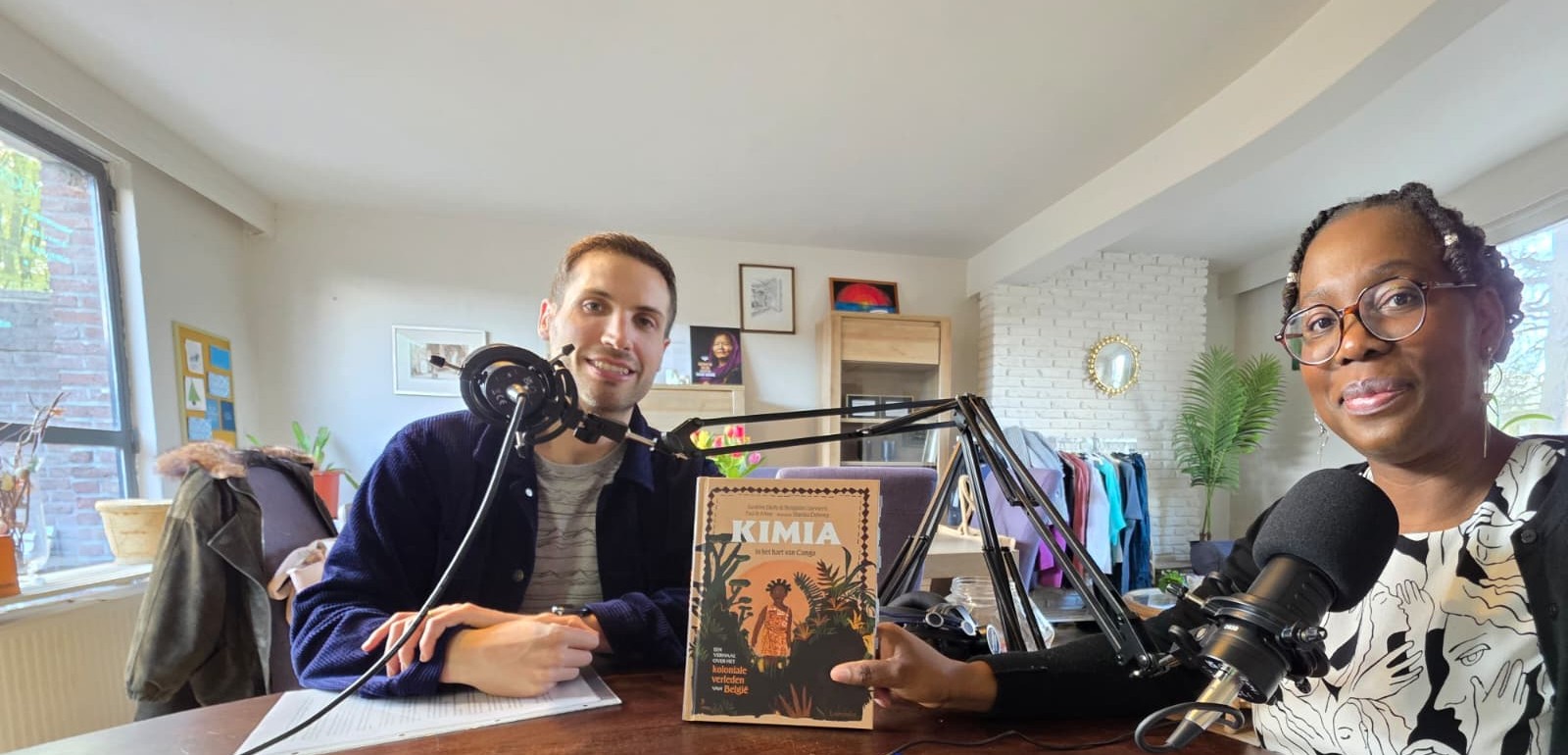
Kimia in het hart van Congo by Sandrine Ekofo, Benjamin Goyvaerts and illustrator Shamisa Debroey was the starting point for this conversation. Don't want to miss an episode? Subscribe to Kom Maar Dichter on your favourite podcast platform, and join The Conversation Layer — and each conversation, transcript and extra reflection will land straight in your inbox.