This conversation touches on sensitive themes, including racism, domestic violence and mental health.
Bintje, a sharpened version of myself
Bintje lies very close to Tuly — "a bit of a mirror." The name is no coincidence: Tuly was named after her father's childhood sweetheart, Tulynabintu, and chose that same name for her protagonist. After publication she even had "Bintu" tattooed on her arm, as a permanent reminder of the writing process. The book is a novel with a great deal of fiction, but just as many autobiographical elements; Bintu, Tuly says, is "a sharpened version of myself," in which certain aspects of her personality are magnified. Initially she wanted to write a memoir, but ultimately chose fiction to protect herself and, above all, her family.
Not every scene has to be intense
As a journalist (for Het Nieuwsblad, De Gentenaar, rekto:verso and Mo*, among others), Tuly had a tendency to seek out the rawest, hardest story — a tendency she had to temper in her novel. The book deals with domestic violence and racism, and for a long time she felt a scene had to be "terrible" to be worth writing down. But a novel also needs air: the reader has to be able to breathe now and then. It was above all the Schrijversacademie (Writers' Academy) in Antwerp, which she began during the pandemic, that helped her get that air into the story — a two-to-three-year trajectory under the guidance of experienced writers, at the end of which the book was finished.
Solitary and connected
Writing makes Tuly happiest when she's alone, at her writing desk — but she doesn't like working in the abstract. Sensitive to criticism though she is, she needs feedback, because she can lose herself in details and drift from the core. It's an interplay: a process in solitude, but with others who bring her back to the essence. Her ideal writing spot — a garden house overlooking her vegetable patch — she still has to negotiate with her partner, who has commandeered it. She wrote Bintje "between the soup and the potatoes," as a mother of two small children; these days she rises at 5 a.m. to write until 7, her favourite moment of the day, with a still-empty head. It costs social sacrifice (in bed by 9), but it works. She takes inspiration from Toni Morrison, who called any day she hadn't seen the sun rise a lost day.
When did she know this book had to exist?
No single moment, but an accumulation. The pandemic and the first lockdown gave her, for the first time, room to reflect, and intuitively she began to write — something she hadn't done since childhood. A story flowed from her fingers about her father, about how she imagined him in Congo, where he lived until he was twenty. She submitted it to a writing competition and won. She then also won the Kif Kif writing competition — to her great surprise, being insecure by nature — which gave her the support and feedback to go to the Writers' Academy. It grew organically, partly thanks to her partner, who believed in her. It also coincided with a work-related depression: in that period when almost nothing worked, writing still did, and gave her fulfilment. That's when she knew the writing had to stay.
Writing as therapy, with a golden lining
Tuly knows some writers detest the idea, but for her writing was a form of therapy — a "golden lining" over a difficult period. It returned her to something she had lost sight of for twenty years: being occupied with her imagination, her memories, herself. The joy she felt as a six-year-old learning to read and write, she had lost during her teenage years — under the pressure to perform and, as a person of "double blood," to fit in and stand out as little as possible. Many people ask whether it wasn't hard to write down the intense things, but for Tuly it was actually a pleasure: the memories lay far enough away to look at with distance.
Becoming aware of your body and your skin colour
"At school I didn't want to stand out, but my body worked against me." People often say children don't see colour, but Tuly shows the opposite: never was she so aware of her skin colour as during her first years of school. It was the small things that did so much harm — a teacher showing a photo of an African child and asking "who does this look like?", a birthday party she wasn't allowed to attend because she was "a brown child," children asking whether that skin colour could be washed off. Her mother didn't know what to do with her hair and sent her to a Flemish hairdresser who cut it short; later a hairdresser applied caustic relaxing cream to her scalp, leaving burns, but her hair was straight — and she was glad of it. "You completely undo yourself, just to fit in." She grew up mainly with her white mother, surrounded by white people, with no mirror — and that was lonely.
From "half" to "double"
"A half is less than one." That's how Bintje felt, and how Tuly felt: half white, half Black, fully at home nowhere. She now deliberately uses the term "double blood" instead of "half blood" — the evolution from believing you're only half to realising you're double, that your dual origin is a richness. But that road from half to double she hasn't fully travelled; in her head she's still a "half blood." Precisely for that reason the word doesn't feel to her like "just a word": she's convinced language matters in the emancipation process, but it's laden with emotion, and it's sometimes hard for her even to claim the word "double blood" for herself. She's envious of people — often with a mother of another origin, whereas her Congolese father was absent — who carry their roots far more naturally and confidently. The father's absence also meant the absence of the culture.
Language as a wound
Bintje doesn't speak the mother tongue of her father, and Tuly too learned no Swahili, Lingala or French from hers — partly because he had to learn Dutch from her mother. There's a lot of shame around it. She studied French because she felt it important to master the language, but you can hear she's Flemish when she speaks it; when she has to read a French sentence from her book at a reading, she feels ashamed — "I'm half Congolese and can't even read this like a real Congolese person." The standards she sets herself are so high that she doesn't begin. One day, with her children a little older, she'd like to learn it together — something connecting.
Humiliation outside, power inside
Bintje's father is treated with racism on the street and by his in-laws, but is violent toward the mother at home — as if to "patch up" that place. Tuly tried to show how it is precisely because of his vulnerable position in society that he wanted all the more to be the big man, the tyrant, at home. She looked for an explanation — why does someone beat his wife, sow psychological terror? Perhaps because he wasn't seen as a man in Belgian society, because of his skin colour and origin. A story she fabricated, she admits, because how far it's really true she doesn't know; you always look for explanations for your parents' behaviour in order to live with it.
Loyalty, and the "un-event"
The immense loyalty of children toward parents comes strongly to the fore — the search for explanations for behaviour that is, in fact, wrong. As a child you need to be able to see your parents as heroes, at least up to a certain age; when you can't, the blow is so great that you develop a coping strategy you can hardly free yourself from as an adult. Somewhere in the book is the word "un-event" — something that happened, but which the child pushes away as coping. And at the same time: what Bintje doesn't resolve in her life pops up again in the life of her son, as if something has to be told, and if this generation doesn't do it, the next will.
Trauma that heals across generations
Tuly deliberately chooses to believe that the suffering parents and ancestors carry can, at some point in the family tree, be mediated by a later generation, repaired, or lived through in a creative way — into something beautiful. That she finds a far more beautiful idea than suffering passed on endlessly without end. She sees it in third- and fourth-generation migrants, who wonder what their family lost on the way to Belgium — questions their parents or grandparents had neither the space nor the energy for. Sometimes she sees herself as a channel for all the experiences, and all the pain, of her parents and grandparents, which must come out through her pen — so that they are seen, and she is too. (Her brother calls her a hopeless optimist.)
The stigmatising language — and why it had to be there
The book carries a disclaimer about stigmatising language: had Tuly omitted those words, it would have given a distorted picture. She stands by that. Leaving the words out would "let the white reader off the hook" — not that every white reader is responsible, she stresses, but she wanted readers to climb into Bintje's skin and feel how painful it was. Some within the anti-racist community feel such words should never be used, not even in books that set out to denounce that very thing, but Tuly disagrees: concealing how bad it was helps no one. Today's generations need to know how it was in the 1990s, or they won't grasp what was fought for. Former classmates she'd lost touch with reached out after the book: "we didn't know you went through all that." She needed this story to make even those close to her understand how it was — though she regrets receiving far fewer responses from readers with a migration background than from white readers, a group she'd like to reach better, since she wrote the book above all for them and for herself.
Bob Dylan, and the pain like a corkscrew
The air in the book comes partly from music. Tuly refers to Bob Dylan's "You're a Big Girl Now" — that song always brings tears to her eyes. For her, it's her father speaking to her about his mistakes and the loss, the realisation that he can't turn back the clock now that she's grown. Only later did she discover Dylan wrote it after the end of a love affair — "no, this song is surely just about me and my father." The pain that goes through the heart like a corkscrew is, for her, the loneliness of being of double blood, of growing up with an absent father so often belittled before her eyes.
The wounded child, and writing as connection
The wounds the book is partly based on, Tuly still carries with her every day — more consciously than before, and she works daily on dealing with them in a healthy way, even if she doesn't believe they can be fully healed. "I'll always remain a wounded child searching for the stories of other wounded children." Precisely for that reason she wants to write stories in which others recognise themselves and find comfort. Seeking connection with others through their stories is, for her, an important form of healing — she found it herself partly in Bob Dylan's words, and that's what she tried to do for others with Bintje, even if only for a single person.
What comes next
The publisher asked for a Bintje 2, but Tuly doesn't feel ready for it yet. She's now writing a kind of love story — a sidestep, though racism and diversity are in it after all — to train her "writing muscle" for larger work. She dreams of writing a novel for each family member, with, as the crowning piece, a historical book about her grandfather, who turned out to have been a minister in Eastern Congo — a story that requires research in Congo, which doesn't fit her life with small children right now. Therein the writer's life (which is, for her, also a part of her Congolese identity) chafes against life as a mother (which feels "very white") — a path she's still finding her way along.
The last word
To close, Tuly reads a passage in which the small Bintje is at school and her father comes to collect her too early — two worlds she would rather have kept apart. Her heart swells with pride when he walks into the classroom, until the teacher calls the children over "because they may never have seen a Black man before," and her classmates rush forward, jeering, and tear the bloodied plaster from his neck.
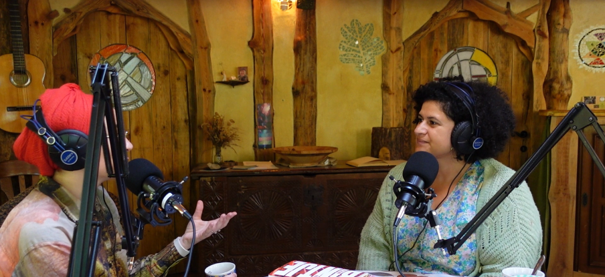
Bintje by Tuly Salumu was the starting point for this conversation. Don't want to miss an episode? Subscribe to Kom Maar Dichter on your favourite podcast platform, and join The Conversation Layer — and each conversation, transcript and extra reflection will land straight in your inbox.